
If you’d like to read this article in Japanese, you can find it here.
This is the sixth post in my solo travel series exploring Hiroshima and Miyajima.
If you’re new to this series, feel free to check out Part 1, where I share some recommended spots in Hiroshima.
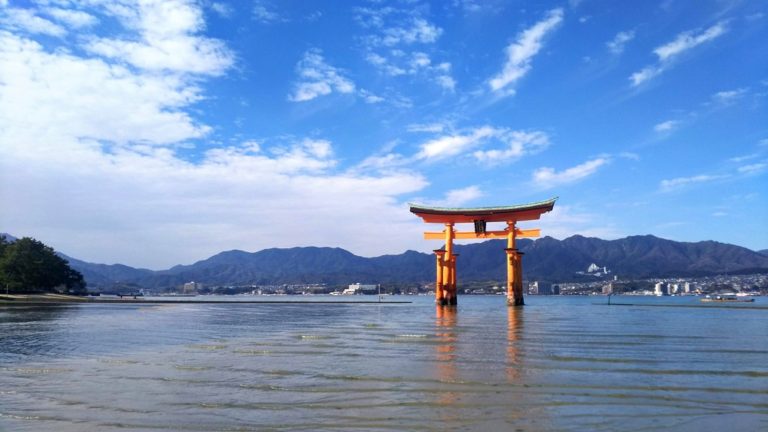
On this visit, I finally made it to Itsukushima Shrine—a UNESCO World Heritage Site.
I experienced both low tide and high tide, and the contrast between the two was honestly unforgettable.
Along the way, I also stopped by Daiganji Temple, a quietly comforting “power spot,” and discovered the serene Nagahama Shrine.
If you’re planning a trip to Miyajima, I hope this gives you a few helpful ideas.
I finally made it to Itsukushima Shrine 💛
It was registered as a UNESCO World Heritage Site in 1996!
Now I understand why—it was breathtaking.
I can’t wait to show you.
Alright then, let’s continue the journey.
You can also check the previous part here:
(This article is based on my trip to Hiroshima in 2020, now revisited and rewritten.)
Daiganji Temple — A Quietly Refreshing “Power Spot”
After finishing my hike up Mt. Misen, I started wandering without any particular plan.
Then, a temple suddenly appeared before me.
That was my first encounter with Daiganji Temple.
Later, I learned that it actually has several fascinating features—like a rare pine tree that splits into nine trunks at the base, and even a model of Kintaikyo Bridge that was once exhibited at the Paris Expo.
But since I hadn’t done any research beforehand, I walked right past all of that without even realizing it.
What a missed opportunity…
Still, what stayed with me most wasn’t any specific attraction—it was how the place felt.
There was a gentle openness to it, and just being there felt quietly refreshing.
Looking back, I wish I had planned for it and taken my time.
Daiganji Temple is located just behind the exit of Itsukushima Shrine.
Since the shrine is one-way and you can’t return to the entrance, I’d highly recommend stopping by Daiganji right after your visit.
It’s one of those places that simply feels good to be in.
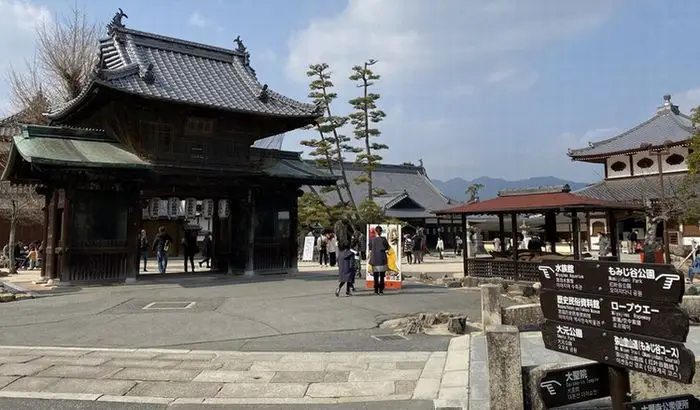
Main Gate of Daiganji Temple (Image from an external source)
Itsukushima Shrine at Low Tide — When the Water Recedes
And finally, it was time to visit the famous Itsukushima Shrine.
To be honest, I didn’t think much about the timing—I just showed up.
If you’re someone who plans carefully, this probably wouldn’t happen to you.
But of course… it was low tide.
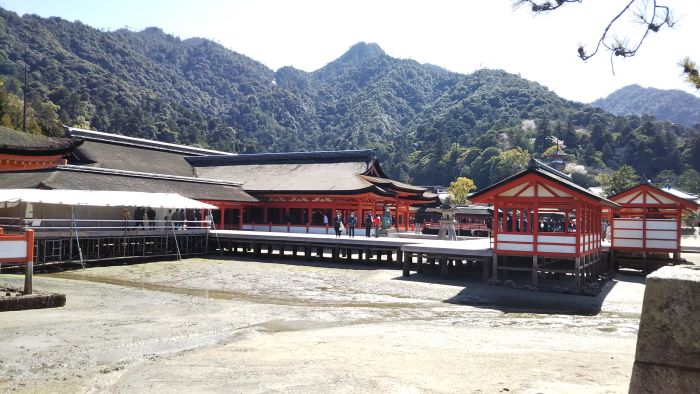
The water had receded completely, and the shrine stood on exposed ground.
Wait… this doesn’t look like the photos at all?!
I had really wanted to see it surrounded by the sea.
To be fair, the tide schedule is clearly displayed at the ticket counter.
(Though by the time you see it, it’s already a bit late!)
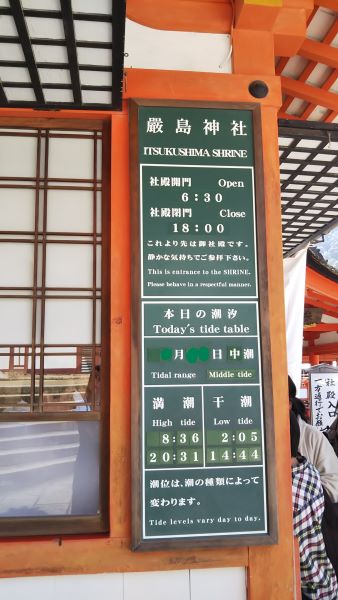
Still, I had come all this way, so of course I went inside.
The last time I visited, it was under renovation and I couldn’t enter, so this was actually my first time properly exploring the shrine.
It felt a little special.
The long corridors were beautifully maintained, and there was something quietly peaceful about walking through them.
One unexpected perk of visiting at low tide was being able to walk all the way up to the Great Torii Gate.
Although it was under renovation, I found myself enjoying the relaxed atmosphere.
There’s something I love about watching people wander freely, taking their time.
And from the torii side, I could capture photos of the shrine from angles you simply wouldn’t get at high tide.
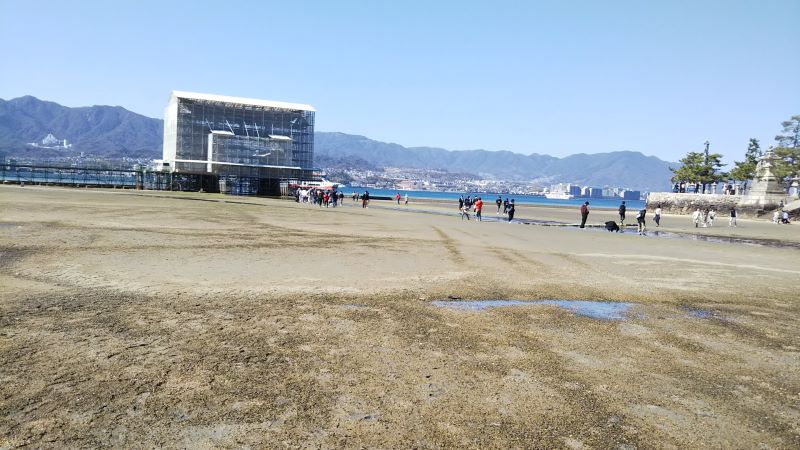
Unfortunately, the famous Great Torii was under renovation at the time.
Itsukushima Shrine at High Tide — Surrounded by the Sea
Even so, I couldn’t shake the feeling that I needed to see it at high tide.
So the next morning, before moving on, I took the ferry back to Miyajima.
This time, I planned my visit around high tide.
Since I had come this far, I didn’t want to miss it.
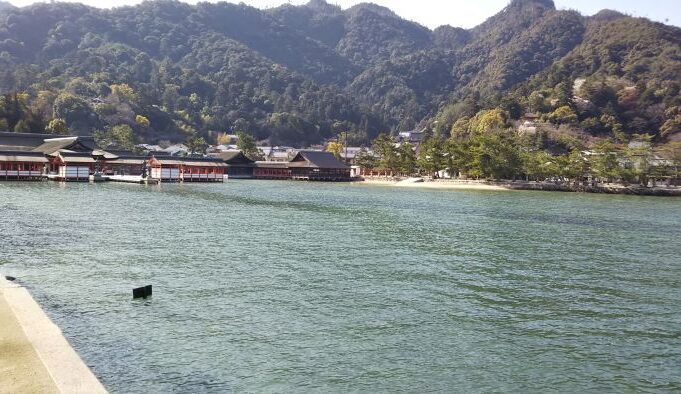
The sandy beach I had walked on the day before was now completely covered by water.
It was a quiet reminder of how powerful nature can be.
The shrine was now beautifully surrounded by the sea.
Even though the Great Torii was still under renovation, it was still an incredible sight.
Standing there, I couldn’t help but think—what an extraordinary place for a shrine.
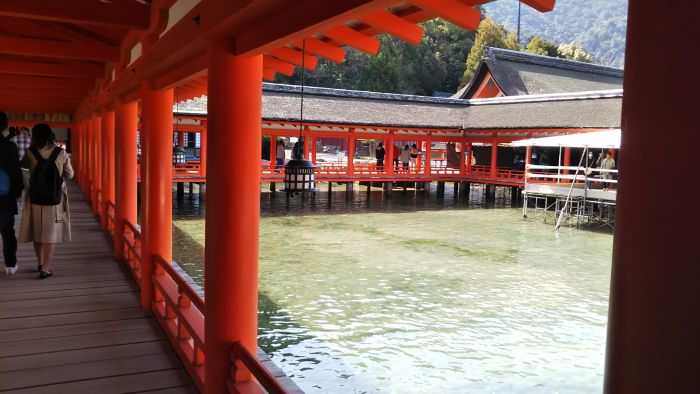
If you want to see Itsukushima Shrine at its most iconic, visiting at high tide really makes a difference.
Inside the shrine, I drew an omikuji—a traditional Japanese fortune slip you can receive at shrines (I’ve always loved these).
And I got Great Luck 💖
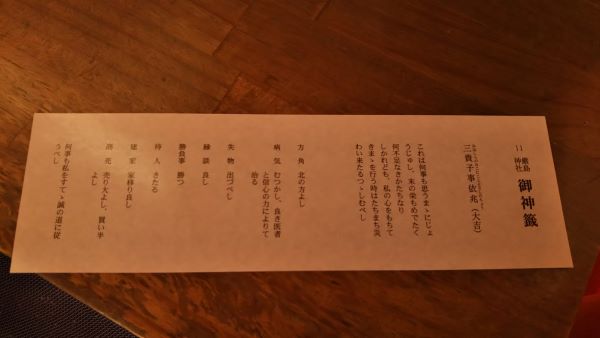
Omikuji fortune slip — I got “Great Luck” (Daikichi)
I left the shrine feeling light and happy.
Nagahama Shrine — A Quiet Torii by the Sea
On the ferry ride to Miyajima, I had noticed a torii gate standing out in the sea.
At first, I thought it belonged to Itsukushima Shrine.
But as I mentioned earlier, the Great Torii there was under renovation.
When I looked more closely from the shrine grounds, I noticed another torii further to the left.
Curious, I decided to go see it for myself.
It’s about a five-minute walk from the ferry terminal, in the opposite direction from Itsukushima Shrine.
That’s Nagahama Shrine.
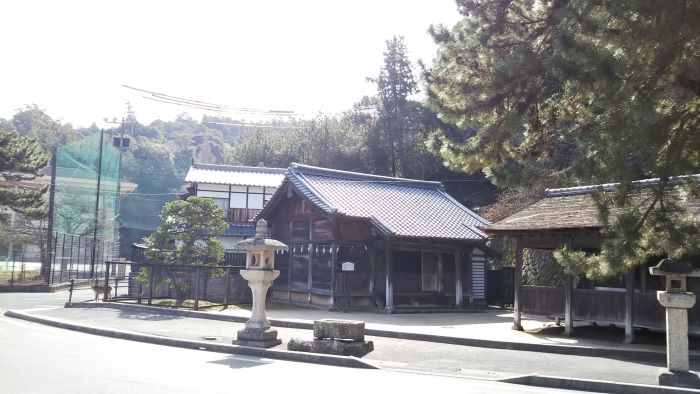
It stands quietly by the roadside—I almost missed it myself.
Across the road, the sea stretches out—and there, firmly rooted in the water, stands the torii gate.
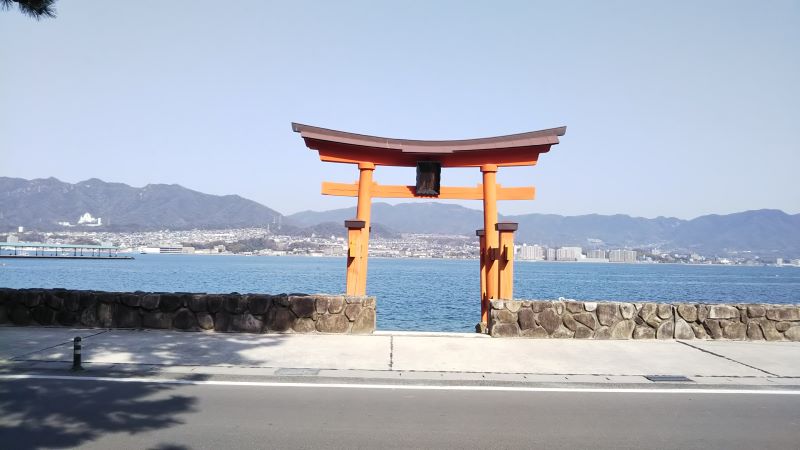
I loved the way the ocean stretched out beyond it.
It’s not as grand or well-known as Itsukushima Shrine, but there’s something deeply charming about its quiet presence.
Small, simple, and somehow very endearing.
Apparently, it’s about one-ninth the size of the Great Torii at Itsukushima.
And then—suddenly—a deer showed up.
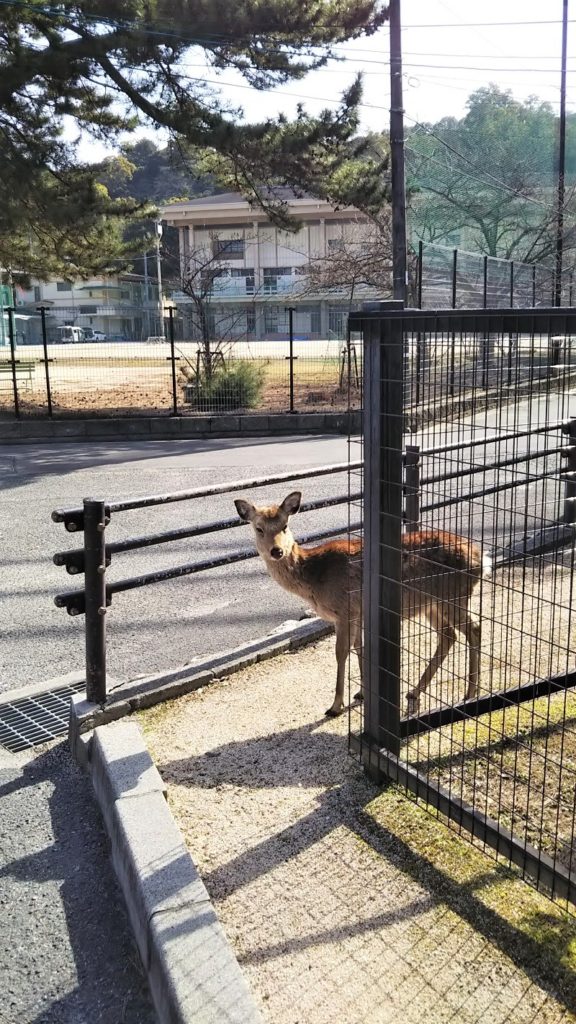
Why are you here?!
It looked a little too close to the road, so I couldn’t help but (mentally) scold it to head back to the mountains.
Miyajima Travel Reflections — Hiking, Shrines, and Serendipity
Since I was short on time, there were still places I couldn’t visit.
For example:
Oomoto Shrine
Miyajima Aquarium
The Five-Storied Pagoda and Toyokuni Shrine (Senjokaku)
Misen’s Okunoin Shrine
Nishimatsubara and Kiyomori Shrine
These were all places I only discovered after arriving—and found myself wishing I had time to explore.
I guess that’s part of traveling, too.
Moments like that make me think it might be better not to plan everything too tightly.
To leave space for the unexpected.
A journey where you can simply wander and stop wherever draws your attention—that’s something I really admire.
(I tend to be the type who plans everything carefully.)
Looking back on this trip—
I hiked Mt. Misen,
saw Itsukushima Shrine at both low and high tide,
and visited peaceful spots like Daiganji and Nagahama Shrine.
It truly felt like I experienced the essence of Miyajima in my own way.
If you’re planning a visit, I definitely recommend checking the tide schedule beforehand—so you don’t end up like me.
Well… things like that happen too.
With a little preparation, I think you’ll enjoy it even more.
Personally, I’d love to come back in autumn and see Momijidani Park near the ropeway station when the leaves turn red.
It looks absolutely breathtaking.
With that new wish in mind, I wrapped up my time in Miyajima.
Next, I’ll share some of the local food I enjoyed in Miyajima—don’t miss it →
Thank you so much for reading.
If you’d like to read this article in Japanese, you can find it here.
 しめいの開運日誌" width="1000" height="353" >